Thomas Beale
The WhaleThomas Beale was a surgeon whose experience aboard a whaling ship turned him into one of the nineteenth century’s most consequential firsthand students of the sperm whale. His Natural History of the Sperm Whale brought together anatomical observation, accounts of life at sea, and reflections on the animal’s place in human commerce; its facts and narrative range would become an important source for Herman Melville. Beale’s authority came not only from what he recorded about whales, but from having seen them alive and from his willingness to look critically at the human world built around their pursuit.
Medical training and the voyage
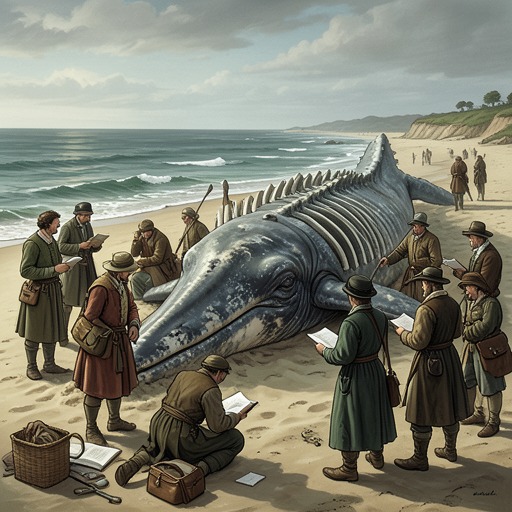
Beale studied medicine at Aldersgate from 1827 to 1829. He remained at the school first in its dissecting room and then as curator, before moving to the London Hospital on Commercial Street. In 1830, aged twenty-two, he left medical work ashore to sail on the Kent, a whaling ship commanded by William Lawton and owned by Thomas Sturge. The voyage gave him a vantage point few writers on whales possessed: he could compare the animal’s life at sea with the limited and often secondhand descriptions circulating among people who had never encountered a living sperm whale.
The Kent travelled down the coast of South America, rounded Cape Horn, crossed the Pacific, and continued to Hawaii and the Kamchatka Peninsula. Beale watched whales being hunted and made extensive notes on their behavior and physiology. His journey coincided with Charles Darwin’s voyage on the Beagle, though Beale’s scientific work grew out of the practical and often violent circumstances of a whaling expedition. He had travelled roughly fifty thousand miles by the time he returned.
That experience also exposed him to the ship’s hierarchy. Beale was appalled by the treatment of the crew and concluded that he could no longer endure witnessing it. At midnight on 1 June 1832, at the Bonin Islands, he left the Kent and joined another ship belonging to Sturge, the Sarah and Elizabeth. Its captain, William Swain, offered a more temperate command, and Beale sailed home aboard it. His departure makes his account more than a record of natural history: the same voyage that brought him close to whales also brought him face to face with the working conditions of the men sent to hunt them.
A firsthand natural history
Back at his home in Bedford Square, Beale set out to address what he regarded as a striking lack of reliable knowledge. In his view, the habits of an animal so remarkable and so commercially important had been largely neglected; even its outward form remained unfamiliar to the public. He pointed to William John Huggins’s image of the South Sea Whale Fishery as an influential exception, an image that continued to shape popular depictions of whaling long afterward.
The year after his return, Beale presented a paper on Physeter macrocephalus to the Eclectic Society of London, which awarded him its Silver Medal. He published an illustrated booklet in 1835, then spent four years expanding it into Natural History of the Sperm Whale, published in 1839. The book combined scientific description with travel narrative rather than separating the whale from the circumstances in which it was observed. Its frontispiece depicts a turbulent encounter in which whales toss boats and send harpoons and people into the air; its chapter headings range from observations of whales and unfamiliar places to the shipboard abuses that led Beale to leave the Kent. Natural history, adventure, and social testimony occupy the same pages.
Beale’s account also challenged assumptions about what the sperm whale needed in order to live. He described three hunted animals, one blind and two with deformed jaws, that were otherwise in good condition. He took this as evidence that the whales did not require either their teeth or their eyesight to feed. The whale, he argued, did not chew its prey but drew it in; he also proposed that squid might be attracted to the animal’s mouth by its appearance and powerful odor. Later science revised this explanation of how prey is obtained, but the episode shows Beale reasoning from the condition of actual animals rather than treating inherited claims as settled fact.
His observations extended to social behavior and vulnerability. Beale noted the care females showed toward their young and described companions staying near an endangered whale rather than abandoning it. Whalers exploited this tendency to gather together when threatened: the behavior that helped protect a group from predators could make an entire school easier for hunters to approach. Beale’s description therefore records both the strength of social attachment and the danger of that attachment in a hunt. He also observed that young whales could remain near a ship for hours after their parents had been killed, a detail that makes the consequences of whaling visible beyond the immediate capture.
The whale and the human economy
Beale’s interest in whales did not stop at anatomy or behavior. He considered their place in the human chain of consumption, and his writing connected the pursuit of whale products to the exploitation of people. His book was dedicated to Thomas Sturge, whose support for the anti-slavery cause Beale acknowledged. The dedication places the whale’s treatment beside human emancipation, not as an identical experience, but as a deliberate moral comparison that runs through the work.
He also described whaling as a force in the movement of people and the making of settlements. Beale argued that British colonies in Australia might not have existed without whaling ships approaching their shores, and recorded that vessels had helped save early settlers at Botany Bay from starvation. Ships that went outward with available space could carry convicts to the settlements; in turn, established colonies later supplied sperm oil to Britain, reducing the time and capital required for the trade. In Beale’s account, whaling was thus not a remote commercial specialty. It connected maritime expansion, colonization, transport, and the circulation of whale products across oceans.
Scientific legacy and continuing questions
Natural History of the Sperm Whale provided Herman Melville with a framework for making the whale both a subject of factual inquiry and a presence in a larger narrative. Melville drew directly on Beale’s descriptions, and the book’s influence extended beyond cetological detail to its other preoccupations. Beale’s blend of observation, maritime episodes, and questions about human conduct offered a model for writing about a creature that was at once an animal, a source of wealth, and an object of imaginative speculation.
Beale’s inquiries into ambergris show the same mixture of close attention and uncertainty. Drawing on chemical observations and specimens, he argued that ambergris was hardened material from the sperm whale’s digestive system. He cited an experiment by Wilhelm Homberg involving the digestion of human waste, a specimen owned by Samuel Enderby that appeared moulded by the whale’s lower rectum, and his own collection of semi-fluid whale excrement in the North Pacific, which acquired ambergris-like properties after drying in the sun. The precise origins of ambergris remain more complicated than Beale’s conclusion, but these examples show him testing an exotic and valuable substance against evidence from the whale’s body rather than treating its commercial mystique as an explanation.
Beale’s importance rests on the range of worlds he brought into contact. A trained surgeon, he travelled as a whaler, recorded the animal from direct observation, criticized abuses aboard ship, and traced the consequences of whaling through commerce and colonial movement. His book preserves the limits as well as the power of nineteenth-century knowledge: some of its explanations were later superseded, while its central insistence—that the whale’s life had been scarcely understood despite the human industry devoted to killing it—remains the force that binds its science, narrative, and moral scrutiny together.